01
Evidence Assessment
Start with the records you have and the questions you want to answer. We assess data quality, identify useful outcomes, and recommend a focused scope of work.
Data inventory · Evidence opportunities · Project roadmap
Real-World Evidence & Outcomes Analysis
Turn your healthcare records into evidence you can use.
Understand your outcomes. Make informed decisions. Communicate the value of your care. Arclight turns clinical records and operational data into structured analysis and clear, source-supported reports.
From records to insight
Clinical notes, measurements, photographs, claims, and product-use records.
Treatment courses, outcomes, utilization, and patterns across patients.
Similar cases, treatment pathways, and published clinical research.
Illustrated healing · Real case-study measurements
Pre-graft · Conservative care
6.04 cm²
Recorded wound size
Area reduction from initial evaluation
Pre-graft · Conservative care. Recorded size 6.04 square centimeters. 0.0 percent area reduction.
Evidence that serves your practice
Every treatment course creates an opportunity to learn. A structured review helps you see how patients progressed, how resources were used, and where documentation and care processes can improve.
Track progress, treatment duration, patient characteristics, and utilization across individual cases and larger patient datasets.
Bring clinical experience into a consistent analytical framework, with published research providing context for your findings.
Give practice leaders, payers, and audit reviewers a clear account of treatment decisions, documented progress, and follow-up.
Choose your starting point
01
Start with the records you have and the questions you want to answer. We assess data quality, identify useful outcomes, and recommend a focused scope of work.
Data inventory · Evidence opportunities · Project roadmap
02
Build a clear picture of care across an individual case or a patient population. We reconstruct treatment courses, reconcile product use, and analyze documented outcomes.
Case reports · Retrospective case series · Outcomes and utilization tables
03
Bring similar cases, products, and treatment pathways into a structured comparison. Connect your findings with peer-reviewed research and randomized controlled trials, then communicate the results in clear evidence reports.
Comparative outcome tables · Literature synthesis · Evidence reports
Built on wound-care experience and available to specialty practices, provider groups, healthcare manufacturers, and other organizations with clinical or operational questions. Each engagement starts with a defined question, the available data, and an agreed scope.
See the work
Gather and map the evidence. Analyze each case. Compare the findings across patients, treatments, and published research. Explore how Arclight turns clinical records into evidence your practice can use.
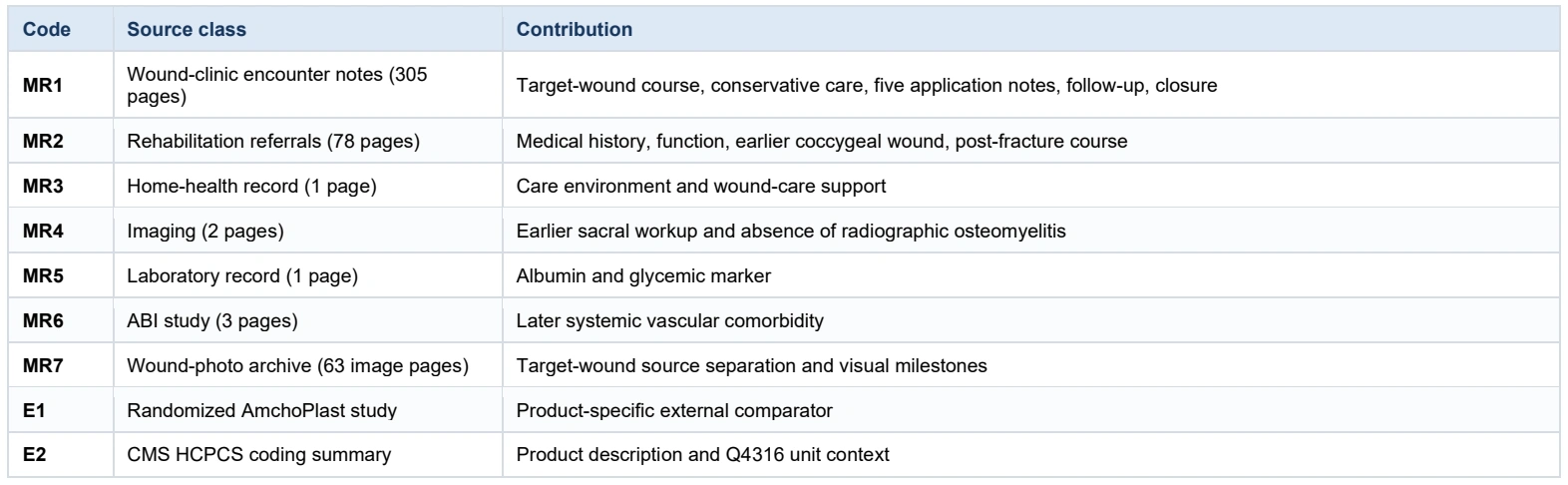
In one nine-page case study, Arclight analyzed 453 pages of clinical documentation and wound images. Encounter notes, supporting records, and photographs were reviewed and reconciled to build a source-supported account of care.
305
Pages of wound-clinic notes
85
Pages of supporting clinical records
63
Pages of wound images
Follow healing from conservative care through grafting and ongoing wound care. In this single-patient case study of a chronic traumatic leg wound, serial measurements show the progression to documented closure.
Replay the interactive healing story| Visit / care phase | Recorded size (cm²) | Area reduction |
|---|---|---|
| Pre-graftConservative care | 6.04 | 0.0% |
| Week 0First graft | 4.44 | 26.5% |
| Week 1Grafting + wound care | 3.71 | 38.6% |
| Week 2Grafting + wound care | 1.67 | 72.4% |
| Week 3Grafting + wound care | 0.68 | 88.7% |
| Week 4Closure documented | 0.00 | 100.0% |
Source: Q4280 case-study collection, pp. 47–48. Clinic-recorded “total area with depth”; area reduction uses the 6.04 cm² pre-graft evaluation.
Arclight can turn your analysis into interactive outcomes stories, illustrated healing sequences, and clear data visuals for your website, presentations, and patient education.
A single case tells one patient’s story. A structured collection of cases helps reveal patterns across similar wounds, diagnoses, patient characteristics, products, and treatment pathways. Arclight brings those findings together with peer-reviewed studies, including randomized controlled trials, to show how your practice’s experience aligns with the broader evidence.
Case studies grouped by wound type, diagnosis, starting severity, and relevant conditions such as diabetes or vascular disease.
What you can learn
Patterns in healing, treatment duration, and follow-up across patients with shared clinical characteristics.
Treatment courses, products, application timing, and supporting care across comparable patient groups.
What you can learn
How documented outcomes and resource use vary across treatment pathways.
Relevant randomized controlled trials, observational studies, and systematic reviews, organized by population and outcome.
What you can learn
Where real-world findings align with published results and which clinical questions remain open.
We align outcome definitions and follow-up periods, assess the comparability of patient groups, and evaluate study quality. The result is a clear account of where findings converge, where they differ, and which questions deserve a closer look.
Comparative outcome tables · Treatment and population summaries · Literature synthesis · Evidence reports
Evidence in action
In a wound-care appeal, an Administrative Law Judge accepted and favorably cited a nine-patient real-world case series and evidence summary. The decision recognized the provider’s use of data to guide treatment selection and track patient progress.
Experience, technology, and judgment
Arclight combines healthcare experience with frontier-model AI-assisted record review, reproducible analysis, and human verification.
We define the analytical question, reconcile the source material, check calculations, and develop findings that can be traced back to the record. Clinical and statistical expertise is incorporated according to the needs of the project.
Projects involving protected health information are scoped around HIPAA requirements, appropriate business associate agreements, approved systems, and controlled access. A secure records process is arranged at the start of the engagement.
Free practice tool
Use the Evidence Readiness Checklist to organize your questions, identify available records, and prepare for a productive project discussion.
Includes prompts for patient selection, treatment history, outcome measures, utilization, follow-up, and data access.