An Arclight Austin Insight
An Arclight Austin Insight by Lance McNeill, Founder & CEO, Arclight Action PBC
Prop I is on the ballot this fall in Austin, and voters will decide it on November 3. Whatever you think of it, three things are worth knowing.
First, what it is. Prop I is a City Charter amendment that would create an Independent Affordability and Efficiency Initiative, an outside review of City spending and operations. The first review must be done within a year of hiring the contractor, the review repeats every five years, and the Council couldn't call an election to raise the City's maintenance and operations property tax rate unless a review had been completed within the year before it.
Second, what it’s supposed to do. The audit contractor would look at affordability, performance, organizational structure, contractor accountability, reducible spending and internal controls, and compare Austin with Texas peer cities. It must commit by contract to identifying savings that exceed its own fee.
Third, where it came from. Prop I reached the ballot through a citizen petition. The petition was filed on June 2, 2026 with 21,131 signatures, and on June 22, the City Clerk certified it.
A petition is a great civic engagement tool, but what if we continue to engage the community even as the audit kicks off? If I were to bid on the contract, I’d propose a challenge-prize-based audit. Here’s what that would look like…
How it would work
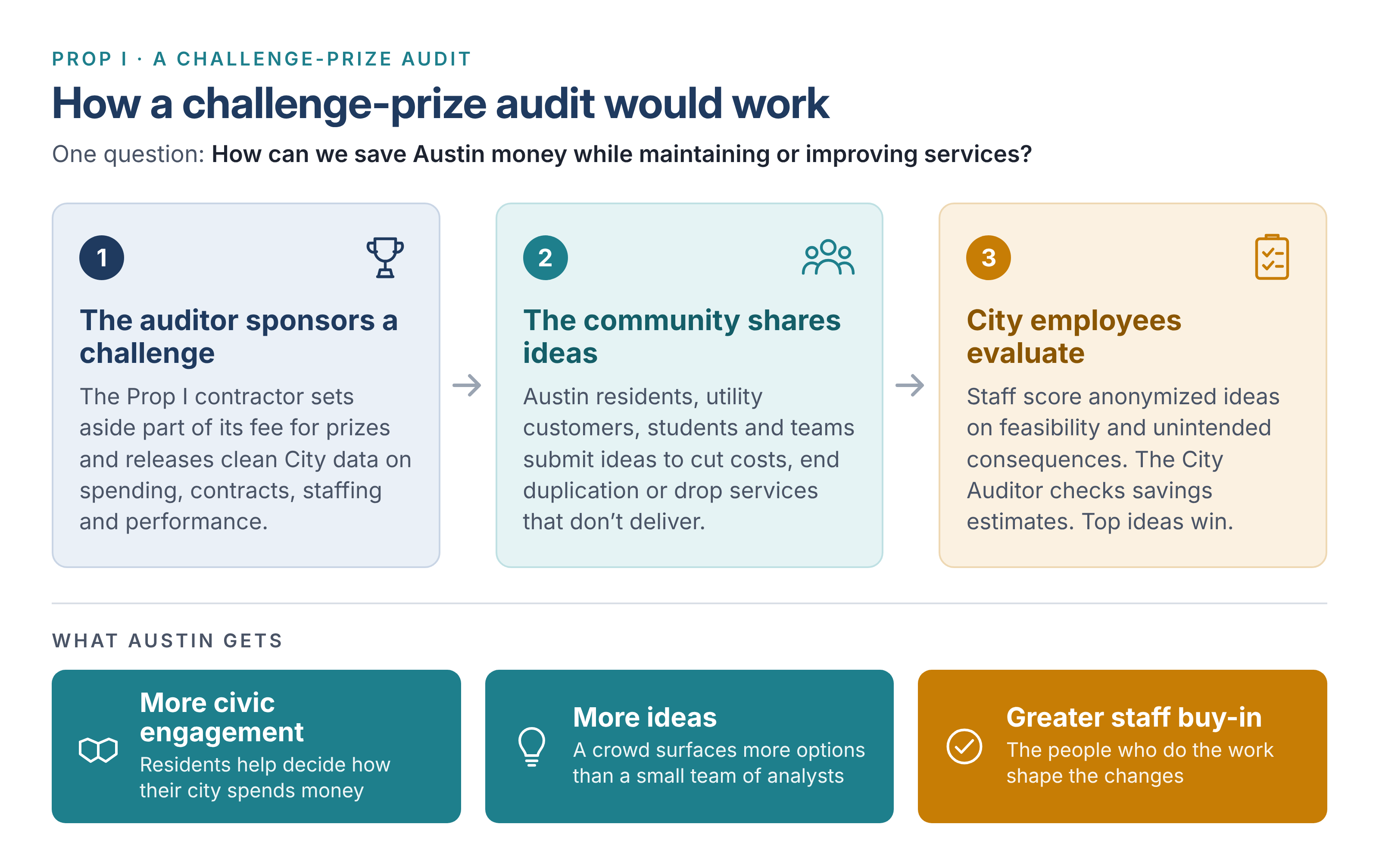
The audit contractor would sponsor a challenge open to the Austin community, built around one question: how can we save Austin money while maintaining or improving services? That question includes finding services that may no longer be needed, that duplicate other work, or that don't deliver results. Our bid would ask the City to release clean data on spending, contracts, staffing and performance so entrants aren't working blind. Based on my experience with challenge prizes, I'd expect dozens of teams and individuals to take part with well over 100 ideas submitted.
Entry would be open to Austin residents and City utility customers. Entrants would show a City of Austin, Austin Energy or Austin Water utility bill, a property tax bill, or another proof of residency in their own name. Students, student groups and teams would be welcome, and minors could take part with a parent's consent. City employees couldn't enter, because they'd have a conflict of interest, but they would play an important role.
Every idea would be anonymized by the contractor. The contractor would help estimate each idea's savings, with a check by the City Auditor's office. City staff would then rate the ideas on objective criteria, for example: whether each is feasible, whether it can actually be implemented, and whether it accounts for unintended consequences for residents and services. The people who do the work every day should have a seat at the table, and bringing them in early builds the buy-in any real change needs. The highest-rated ideas that save the most money would win.
The fee and the prizes
As an example, imagine a $1.5 million contract for the one-year review. The closest local yardstick is the efficiency assessment the Council authorized in July with Public Works LLC whose contract has a ceiling of $5.23 million over an initial three-year term, or about $1.74 million a year spread evenly. A $1.5 million one-year audit contract would come in below that annualized ceiling. It would also mean committing to find more than $1.5 million in savings, a very feasible goal.
Example: From the contractor’s fee, $130,000 would be set aside for prizes.
| Place | Prize |
|---|---|
| 1st | $50,000 |
| 2nd | $30,000 |
| 3rd | $20,000 |
| 4th | $10,000 |
| 5th | $5,000 |
| 6th–10th | $3,000 each ($15,000) |
| Total | $130,000 |
A professional team would still do the core analysis and the forensic review and would check every savings estimate. But I expect a crowd working on the same question to surface more promising ideas than a small team of analysts could on its own, and the prize pays only for the best of them.
Has this been done before?
Governments have paid cash for good savings ideas for decades. Washington State's Productivity Board pays state employees up to $10,000 for ideas that save money. In 2025, a team of state employees, mostly from the transportation department, won awards for replacing a commercial insurance policy on the State Route 520 floating bridge with self-insurance, which the state estimates will save $9.8 million a year. Texas ran its own employee incentive programs, and from fiscal 1990 through 1998 roughly 65,000 Texas state employees received cash awards, with the programs credited with more than $59 million in certified savings. USA.gov reports that the federal government has run more than 1,000 prize competitions since 2010. To be clear, my proposed challenge-prize audit engages City of Austin employees in judging the ideas, but they’d be exempt from any prizes.
The prizes would be open to residents, and this too has precedent. In 2009, New York City challenged developers to build apps that improve the city using its open data. That first NYC BigApps competition encouraged over 80 app submissions competing for $20,000 in prizes.
Austin has done some of this as well. During my almost seven years at the City, I was involved with the [Re]Verse Pitch, a challenge-based competition the City of Austin launched in 2015 with community partners. It asked local businesses and nonprofits to pitch their surplus and byproduct materials to entrepreneurs and residents, and more than 85 social entrepreneurs came to the first event. Mentors helped entrants develop reuse businesses, finalists pitched to judges and the public and competed for $10,000 in startup funds. In 2016, I co-wrote an article about it for the Stanford Social Innovation Review.
My experience and interest motivated me to write a book on challenge prizes, Challenge Us, where I describe the public benefits of these competitions. Applied to Prop I, a challenge-based approach could give Austin three things an ordinary audit report usually doesn't: community engagement in how their city spends money, more ideas than any single contractor could generate alone, and greater buy-in from the City employees who would carry out the changes. Prop I asks its contractor to find savings worth more than it costs. I'd like my neighbors to help find them.
Lance McNeill is the Founder & CEO of Arclight Action, Public Benefit Corporation and the author of Challenge Us: Inspiring the Next Generation of Solution Builders with Lessons from the Past and a Hope for the Future. Reach him at lance@arclightaction.com or 737-330-1126.