In March, an Ohio provider described three patients crying at the bedside while they waited for prior authorization for kyphoplasty or vertebral augmentation. Another provider reported patients calling the office in pain after procedures were delayed and answers failed to arrive for weeks. These accounts surfaced in records the Electronic Frontier Foundation obtained through its lawsuit over Medicare's WISeR model. [1]
What did it mean to call WISeR a test for someone waiting for a procedure?
WISeR uses technology, including AI, alongside clinician review to screen selected Medicare services before payment. Medicare has a legitimate reason to scrutinize unnecessary care. The design of that scrutiny matters just as much when an older person is waiting at home and a provider needs an answer. Records CMS released show a program with unfinished testing before live requests began and substantial backlogs afterward. [2–4]
The rollout at a glance
What was WISeR, and what went wrong?
WISeR is a six-state Medicare model that uses technology, including AI, alongside clinician review to assess selected services before payment. A provider can seek prior authorization or have the claim reviewed before payment. CMS named six participating companies on November 6, 2025; live requests began January 5, 2026.
The timeline follows Ohio participant Innovaccer and its Medicare contractor, CGS. Innovaccer warned CMS in December that its system would not have full functionality at go-live. CGS recorded unfinished testing before intake began and, on April 6, reported 530 requests on hold and 1,874 claims suspended. The figure shows why a scheduled launch date did not prove that the full path from request to usable decision and claim processing worked.
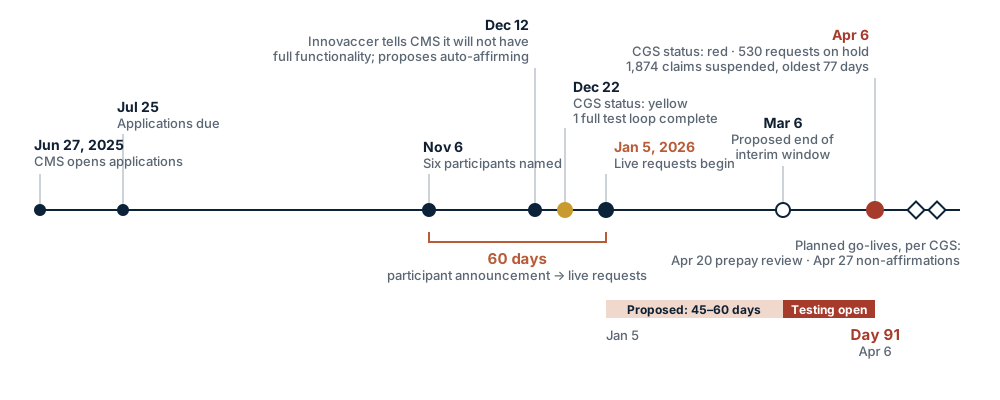
- June 27, 2025CMS opens applications
- July 25Applications due
- November 6Six participants named
- December 12Innovaccer warns CMS it will not have full functionality at go-live and proposes an interim auto-affirming period
- December 22CGS marks Ohio implementation yellow; one full prior-authorization test loop completed
- January 5, 2026Live requests begin, 60 days after participant announcement
- Early MarchThe proposed 45-to-60-day interim window would have ended
- April 6, day 91CGS marks Ohio red: 530 requests on hold and 1,874 claims suspended; the oldest suspended claim was 77 days old
- April 20 and 27CGS lists planned dates for prepayment review and prior-authorization non-affirmations
Sixty days
CMS opened applications on June 27, 2025. Applications were due July 25, and CMS named six participants on November 6. The model formally began January 1, 2026. Providers could submit prior-authorization requests January 5 for services beginning January 15. From the selection announcement to live intake, the vendors had 60 days. [2, 3]
Each company had to fit into an existing Medicare process involving providers, clinical review, three Medicare Administrative Contractors (MACs), claims systems, and appeals. The work spanned New Jersey, Ohio, Oklahoma, Texas, Arizona, and Washington. These were real requests for real patients from the start.
When I worked in the City of Austin's Office of Innovation, I learned to ask what stage a public program had actually reached. A beta can expose technical problems among controlled users. A pilot limits the live population and builds in a way to pause, correct, and learn. A launch makes a service part of ordinary life. CMS called WISeR a model test, but its six-state footprint placed patients and practices inside a national-scale implementation before all of its pathways had been tested.
The December warning
Innovaccer, the Ohio participant, said so in writing. On December 12, it told CMS it would reach January 5 without full functionality. Requirements had changed; beneficiary and provider verification integrations came late; version control and governance were unclear; and there was too little time for end-to-end testing with providers. The company proposed automatically affirming requests while it finished its system. It expected that interim phase to last 45 to 60 days and described it as a way to obtain real clinical documentation for testing. The proposal also warned that later decisions could change, appeals and provider confusion could rise, and early approvals could distort the “gold card” exemption metric. [4, pp. 216–218]
Ten days later, CGS, the Ohio MAC, marked implementation yellow. It had just completed its first full-loop prior-authorization test with Innovaccer. End-to-end prepayment testing remained unfinished. An optical-character-recognition defect sent incorrect beneficiary identifier data and caused unique tracking number (UTN) failures. CGS recommended more testing time and recorded that part of Innovaccer's system would be unavailable at go-live. The request pathway was two weeks from opening. [4, pp. 220–221]
At that point, leaders needed evidence that a request could make the whole trip: from a provider's submission through review, decision, UTN transmission, and claim processing. They also needed to see what happened when an identifier was wrong or a case did not belong in WISeR. The December report gave them one completed full-loop prior-authorization test, unfinished prepayment testing, and a live identifier defect.
The payment design raised the cost of getting those gates wrong. For qualifying prior-authorization non-affirmations, participant payment was set at 25% of a discounted regional benchmark; qualifying prepayment denials used a discounted claim-based amount. The initial quality multiplier could reduce payment to 95% or 90%. In the first performance period, points for the timeliness and accuracy measures came from complete reporting and audit-document submission. Accurate eligibility decisions and reliable case dispositions therefore mattered from the first day. [4, pp. 98–100; 7, pp. 40–42]
What happened after go-live
Innovaccer's proposed 45-to-60-day interim period would have ended by early March. On April 6, 91 days after live intake began, CGS marked the Ohio implementation red. It counted 530 prior-authorization submissions on hold for Innovaccer determinations and 1,874 claims suspended for prepayment review. The oldest suspended claim had waited 77 days. Full prepayment testing was still incomplete, and the process for issuing non-affirming prior-authorization decisions had not been established. Innovaccer's planned dates for those functions were April 20 and April 27. Recoupment-file exchange and parts of gold carding remained unfinished as well. [4, pp. 200–201]
The December report had identified unfinished testing and decision paths. The April report shows those paths still being worked out while live requests and claims accumulated. Ohio provider feedback from March describes the other side of that same rollout: delayed procedures and people in pain asking when treatment could proceed. The provider accounts and CGS counts come from different reports; together they show why a backlog is more than an operational number. [1, 4]
Arizona had a different failure. As of February 17, Noridian's count showed 1,175 prior-authorization requests forwarded to Zyter through the MAC channel that month and no decisions returned through that channel. Noridian wrote that it had received only four decisions in January. Requests sent directly to Zyter were moving through a different path. The same correspondence described 29 decisions for one provider that had arrived but failed to post to Medicare's Common Working File. Noridian eventually identified a fault in its own automated posting process and said it would reopen the affected claims. To the provider, the result was a denied claim attached to a decision that Medicare's system could not find. [4, pp. 237–238]
In Texas, a March 30 Novitas note counted 51 Cohere prior-authorization requests aged at least three days. Fifteen were awaiting correction for UTN creation or dismissal. Thirty-three prepayment claims had aged 46 to 49 days. Those two words, or dismissal, matter. Some requests needed a decision number; others needed to leave the WISeR pathway altogether. [4, p. 234]
I encountered that second problem in my Texas wound-care work. A skin-substitute claim for a non-lower-extremity pressure ulcer was suspended for WISeR prepayment review. CMS narrows certain procedure codes by qualifying ICD-10 diagnoses, so the treatment site and diagnosis determine whether the service is within the model. The practice received an additional-documentation request and had to respond to protect the claim while seeking its return to ordinary Medicare processing. [3, 5]
The reporting guide has a designated exit for an “ineligible Select Item or Service”: dismissal in prior authorization or an ineligible disposition in prepayment review. That exit should happen before the case is treated as a medical-necessity denial. It also needs to be visible in the data used to calculate participant payment. The practice still had work to do. Staff had to identify the scope problem and prepare a response while the claim remained suspended. [3, 4, pp. 104–111]
Design around the full experience
The first questions should have been ordinary ones. Could the clinician get a usable answer before the scheduled procedure? Would the UTN post where claim processing could find it? Who would clear an out-of-scope case? How would the office reach someone when a patient was in pain and no decision had arrived?
I'm reminded of my Humantific training in the Innovation Office at the City of Austin, where I learned to follow what people do, use, think, and feel as they move through a service. Apply that method to a WISeR case and the technical handoffs become visible as human events: a billing specialist searches for a missing UTN; a clinician cannot confirm the procedure; a patient calls again. The fieldwork has to reach all the way through claim adjudication and correction. Building a component is not proof that this full path works. [6]
A smaller pilot could have started with one service, one participant, one MAC, and a defined provider group. Historical and shadow cases could test diagnosis scope, missing documentation, resubmissions, and appeals before a live decision delayed care. A live entry gate would require correct dispositions and UTN posting, a reachable correction path, and a named leader able to pause intake if backlogs or failures crossed a threshold. Expansion would follow evidence from complete cases, including the exceptions that December's testing had barely reached.
The measures should follow people as well as transactions. Record the request date, the planned service date, when a usable decision reached the provider, whether treatment was postponed, whether a claim was stranded by a missing UTN, and how long a mistaken WISeR referral took to correct. Link those events to unique beneficiaries. Then a report of 530 held requests can be read alongside the number of people still waiting for care, and leaders can act before another month of backlog accumulates.
Go back to the Ohio provider's bedside. Three people were waiting for an answer about treatment for their pain. By April, CGS was still reporting unfinished decision and claims pathways in that state's rollout. For the next AI-enabled health program, the readiness review should be able to follow a patient from the first request to the final, usable answer—and name the person who can intervene when the answer does not arrive.
Sources and notes
- EFF, New Records Reveal Problems with Medicare's AI Prior Authorization Experiment, September 2026, provider-feedback section. The Ohio pain-procedure accounts and Texas wound-care example concern separate cases.
- CMS WISeR fact sheet, pp. 1–2; CMS WISeR model page, Participant Information.
- CMS WISeR FAQ, launch timing, turnaround, and diagnosis-narrowed services.
- CMS WISeR Combined Records released by EFF, PDF pp. 98–111, 200–201, 216–218, 220–221, 234, 237–238. CGS marked December 22 yellow and April 6 red.
- Arclight Action, When a WISeR ADR Is Outside the Model's Scope. The Texas example is deidentified; underlying claim records remain private.
- Humantific training materials cited in the source draft: 01 - Workbook_INTERIOR, Strategic Cocreation Process Quick Guide, Empathy Map, Prepare for Fieldwork Template, and Participant Journey Guide. Lance McNeill completed the City of Austin Complexity Navigation Program in Fall 2015.
- WISeR Participation Agreements released by EFF, PDF pp. 40–42; CMS payment methodology. The quality multipliers and first-period reporting rules appear in source 4, pp. 98–100.